
Business identity and contact
Legal, trade, and former names; NAICS and SIC industry codes; identifiers such as EIN, UEI, and CAGE; business websites, phone numbers, and reported contacts.
The current foundation brings together more than 500 million business and reference records from 100+ public and official data sources maintained on their publishing schedules.
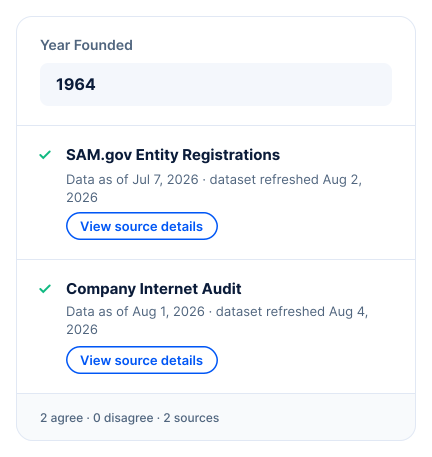
Research a company’s capabilities and recorded activity, or scope a dataset around the details your question needs. Explore examples from the EcosAtlas foundation.
Discuss your projectLegal, trade, and former names; NAICS and SIC industry codes; identifiers such as EIN, UEI, and CAGE; business websites, phone numbers, and reported contacts.
Headquarters, physical and mailing addresses, branches, and facility locations. Geographic coordinates and county context help connect company research to a service area or region.
Products, services, production processes, materials, equipment details, standards, and certifications described in available business information, alongside industries served and service areas.
SAM registration status, registration and expiration dates, business types, and small-business or ownership designations. A reported designation and an agency certification remain distinct kinds of information.
Federal contracts, grants, subawards, and SBA lending records, with reported amounts, agencies, and dates. SBIR/STTR records include research award titles and program phases; opportunity notices add deadlines and set-asides.
Reported employee counts, hiring locations, occupations, requested worker numbers, and offered wages in labor filings. Dated reports can help identify employment changes worth reviewing.
Facility registrations, licenses, safety inspections, citations, environmental enforcement, and transportation records. Relevant case dates and reported statuses help place an event in context.
Patent titles, grant dates, and assignees; trademark filings and statuses; securities and corporate filings. These records can inform research into a company’s technology and reported business activity.
Safety and labor enforcement. Federal contracting and grants. Environmental compliance. Corporate and securities filings. Intellectual property. Trade screening. State registrations. Primary sources used by public institutions themselves.
Read the data FAQ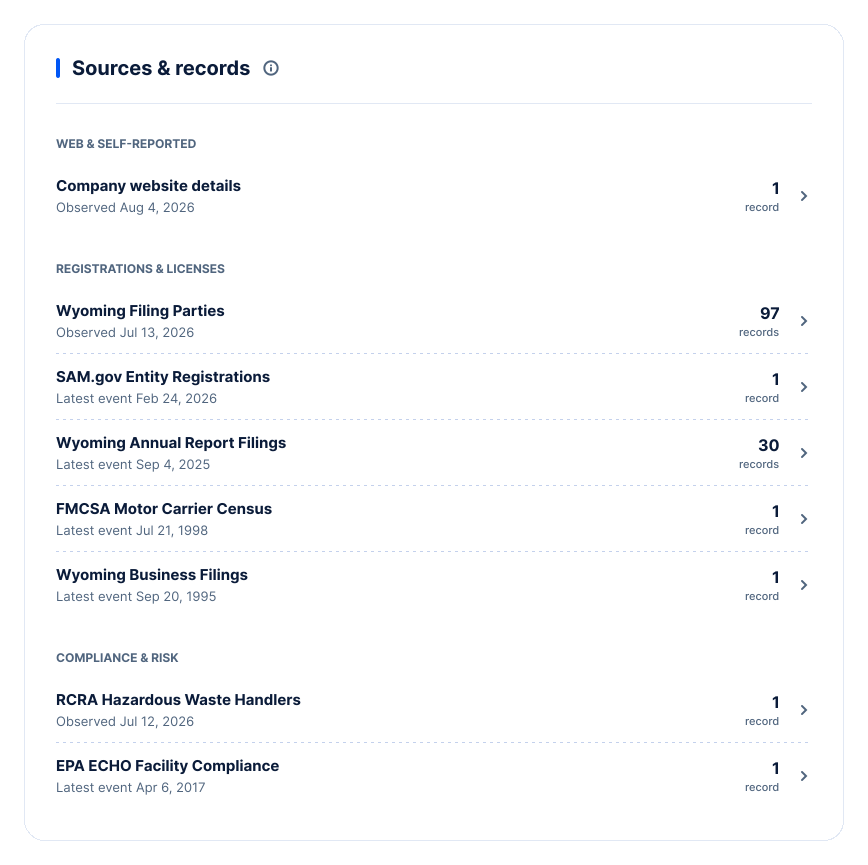
These systems share no common company identifier. The same business can appear under different names, addresses, and numbers. EcosAtlas connects those records into one business identity and holds ambiguous cases for review.
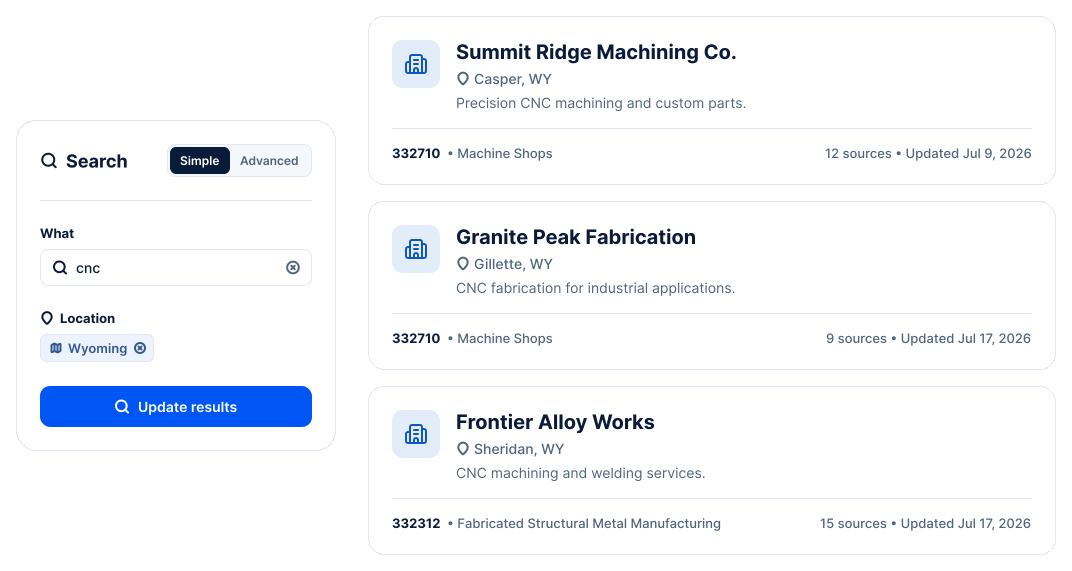
The capability layer is built separately: equipment, processes, materials, products, services, and certifications mapped to a controlled industrial vocabulary.

Businesses can contribute capabilities directly and author a published profile with field-level consent controls.
Beneath the record sits a structured map of industrial concepts and relationships, so the platform can reason about what a process requires, what it produces, and which alternatives may be relevant.
A business question often reaches beyond a single company. EcosAtlas’s knowledge framework brings together industrial concepts, official classifications, geography, and statistical observations for industry and regional research.
This reference foundation supplies context around businesses. Workspace access and custom project scope determine which information you can work with.
Explore practical usesIndustrial processes, inputs, outputs, and equipment relationships sit alongside official industry classifications. Shared concepts help relate company capabilities even when businesses describe their work differently.
Occupation and education classifications provide a common language for relating industries, kinds of work, and training fields in a regional study.
County, tract, place, and regional boundaries combine with roads, rail, ports, waterways, and airport reference data to put a location in its wider geographic setting.
Official statistical observations and geographic risk indicators support comparisons across industries and places. These describe regional context, separately from facts about an individual business.
Each source is collected on the cadence it publishes, from daily to quarterly. When a fact changes, the prior value remains dated and available.
Business identities connected across the United States.
Business source records together with the framework’s industrial, geographic, and statistical reference information.
Public and official sources maintained on their publishing schedules.
All 50 states, DC, and U.S. territories, down to county geography.
Move from how the foundation is built to the workflows it powers.